
Welcome
An approach to guitar that emphasizes understanding, awareness, and long-term musical growth.
My name is Coire (“Cory”) Walker. I teach guitar lessons for students who want to understand music and their playing more deeply, not just learn songs or accumulate material. I have twenty-one years of teaching experience and received my degree from Musicians Institute in Los Angeles in 2005.
Lessons are open to students of all ages and experience levels, from complete beginners to experienced players looking for greater clarity or direction. I currently teach students in Amsterdam and Utrecht, as well as online.
Work is adapted to the individual, with an emphasis on developing musical awareness, confidence, and independent judgment over time. If you're curious about lessons, you're welcome to reach out through the contact page and we can briefly talk about your experience and what you’d like to explore.
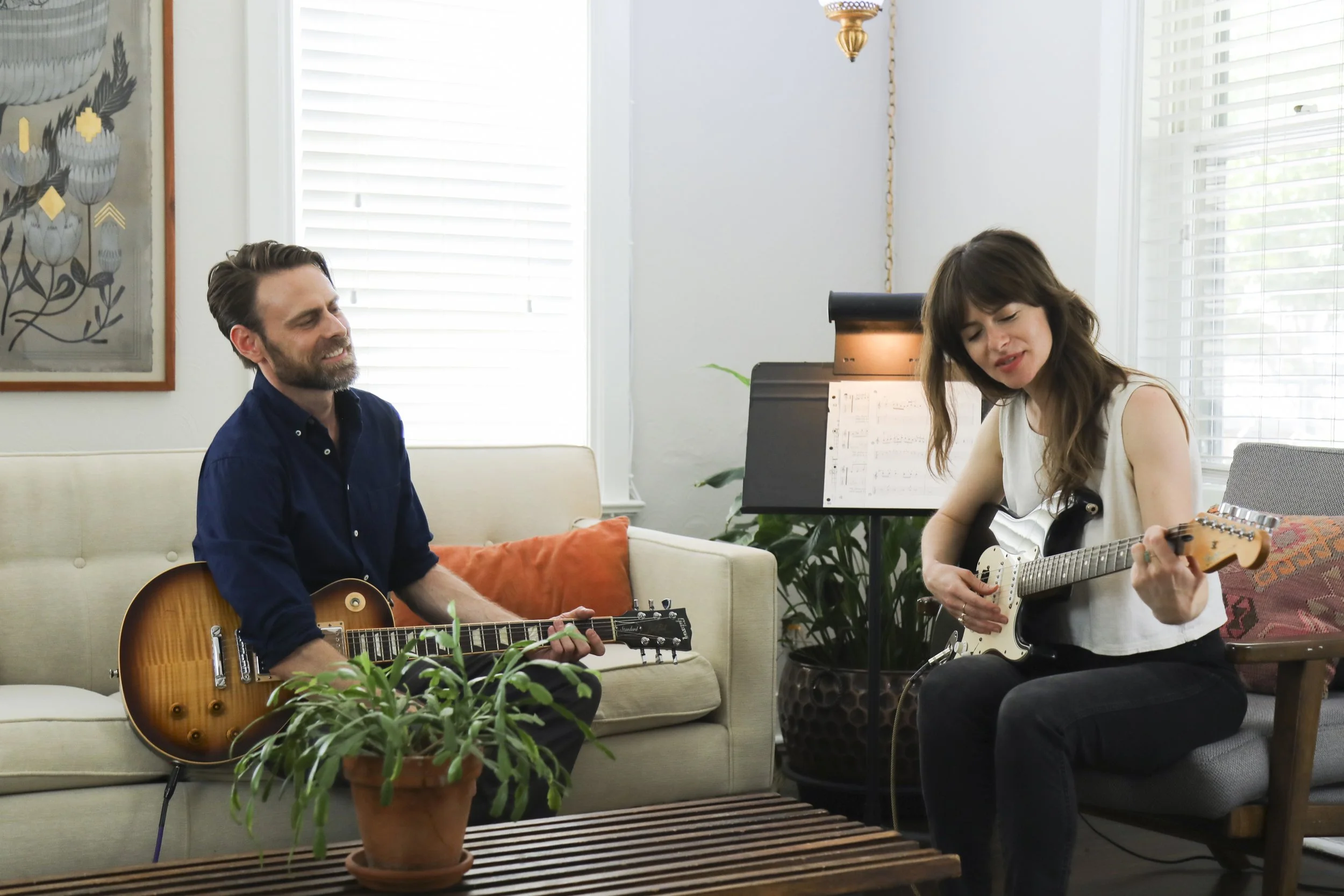
In practice, lessons often include rhythm and strumming development, coordination between the hands, picking technique, fingerstyle approaches, playing and singing simultaneously, articulation in styles such as rock, funk, and metal, lead playing fundamentals, and understanding how the guitar functions in a group setting. Technique is always approached in relation to musical understanding so that it supports expression rather than becoming an isolated goal.
Students arrive at many different stages. Some begin by learning songs and building basic skills, while others come after years of playing but wanting a clearer sense of direction or understanding. Over time the focus shifts from reproducing material toward understanding how music works and how to make independent musical choices. The common thread is curiosity and a willingness to grow beyond where one currently is.
Approach
Cultivating musical awareness so practice becomes intentional rather than mechanical.
I see lessons as an attentive collaboration rather than a transactional exchange. Technique and repertoire matter, but the deeper focus is on developing the awareness that allows music to make sense rhythmically, melodically, and structurally.
In lessons we use listening, attention, and practical frameworks that clarify what is happening in the music and in the body while playing. Progress is sometimes obvious and sometimes subtle, but the aim is to build the capacity to notice, adjust, and trust the process as it unfolds.
Because learning is not linear, consistency and engagement often matter more than short-term results. Long-term improvement grows from the relationship between internal musical awareness and playing technique. My role is to offer clarity, structure, and perspective when it is useful, and space when it is not.
Many of my students have worked with me for years. Some began with no prior experience and have gone on to play full songs confidently, join bands, write their own music, or develop a lasting relationship with the instrument. The goal is not speed but depth and sustainability.
Musical Focus
Building musical skills that transfer across styles and settings.
My teaching is grounded in guitar, with work spanning fingerstyle, folk, funk, soul, blues, indie rock, post-rock, punk, metal, rhythm-driven contemporary styles, and introductory jazz and jazz-influenced harmony.
I’m interested both in the guitar as a solo instrument and in how it functions within a group setting: how parts interact, how rhythm and harmony support one another, and how musical roles shift depending on context. Alongside this, I work with music theory, songwriting, and composition as practical tools for expression rather than abstract systems to memorize.
Across styles, the emphasis remains on underlying musical principles such as rhythm, melody, harmony, form, listening, and intention. These are the tools that allow students to move between styles, write their own music, and express themselves with greater clarity and confidence.
Teaching
An evolving practice focused on helping students develop independence and musical judgment.
Teaching is not a static transfer of information for me. It is an evolving practice. Each student brings a different way of seeing, hearing, and engaging with music, and that exchange continually deepens my understanding of how musical ideas can be approached and communicated. The aim is not to reproduce my way of playing or thinking, but to help students develop their own musical judgment, confidence, and ability to ask good questions. Music is an endless field, and learning how to learn within it is as important as any specific technique or style.