
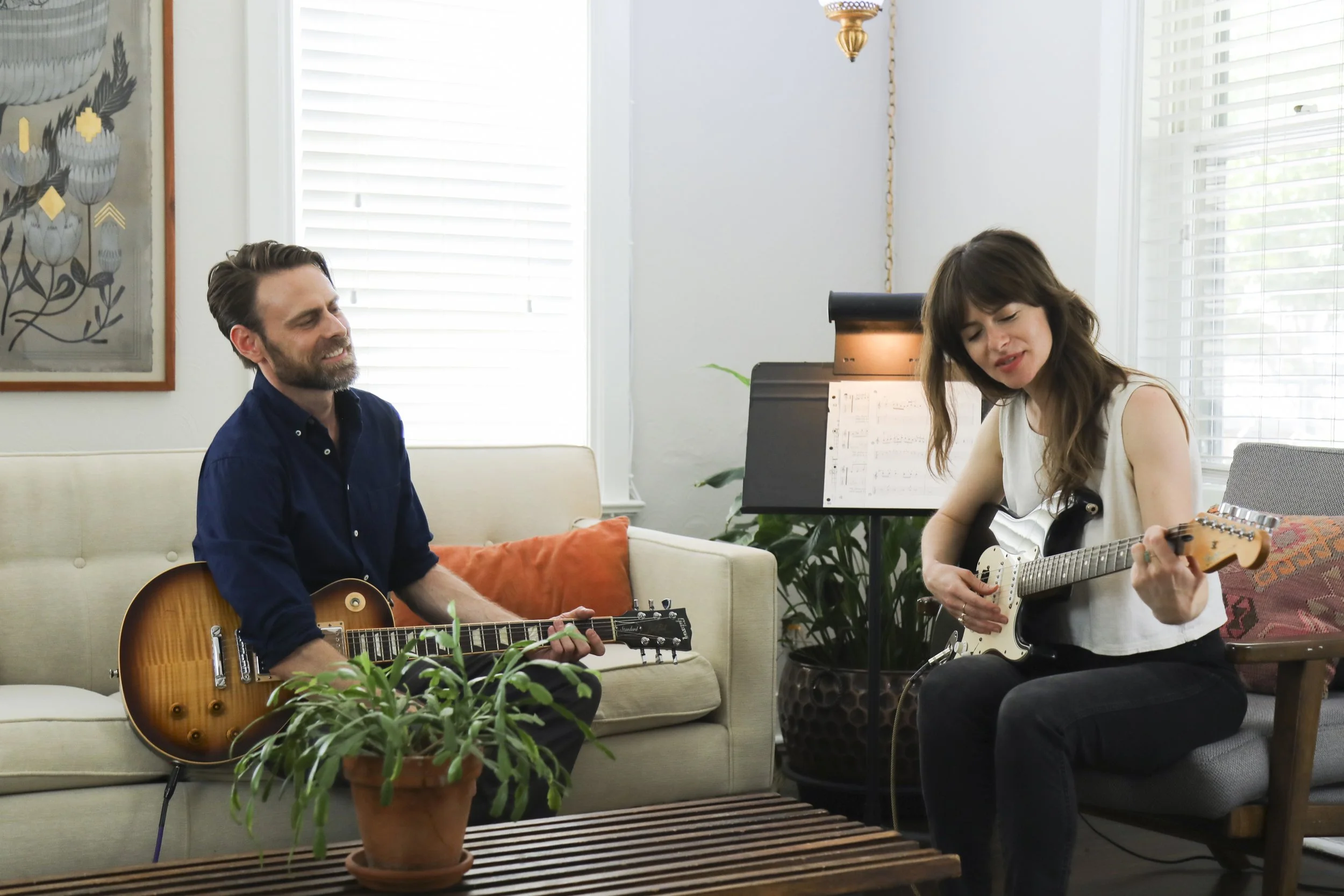
Welcome
Guitar lessons in Amsterdam for adults who want to understand what they’re playing.
My name is Coire (“Cory”) Walker. I’m a guitar teacher with twenty-one years of teaching experience, trained at Musicians Institute in Los Angeles.
I teach students in Amsterdam, and online. I work with beginners, returning players, and experienced guitarists who want clearer technique, stronger rhythm, better musical understanding, and a more confident relationship with the instrument.
Lessons can include rhythm and strumming, coordination between the hands, picking technique, fingerstyle, playing and singing, articulation in styles such as rock, funk, and metal, lead playing, music theory, songwriting, and understanding how the guitar works in a band or group setting.
The goal is not just to learn songs or collect exercises. Songs matter, technique matters, and repertoire matters. But over time, the deeper aim is to understand music well enough to practice with purpose, make better choices, and become more independent as a player.
Students come to me at many different stages. Some are complete beginners who want a serious but patient foundation. Some have played for years but feel stuck, scattered, or unsure how to improve. Others want help with rhythm, technique, theory, songwriting, or connecting their playing to a broader musical direction.
My teaching is best suited to students who are curious, engaged, and willing to practice consistently. You do not need to be advanced. You do need to be interested in learning properly.
If you’re curious about lessons, you’re welcome to reach out through the contact page and briefly tell me about your experience and what you’d like to work on.
Approach
Clear structure, practical guidance, and long-term musical growth.
I see guitar lessons as a collaboration. My role is to help you hear more clearly, understand what you are doing, and build the technical and musical awareness needed to keep improving outside the lesson.
Good practice is not just repetition. It depends on knowing what to listen for, what to adjust, and how to connect physical technique with musical intention. In lessons, we work with concrete material: songs, rhythms, exercises, technique, theory, and musical examples. But the larger purpose is to develop awareness so practice becomes intentional rather than mechanical.
Learning music is not always linear. Some progress is obvious: a cleaner chord change, better timing, a new song, a stronger picking hand. Other progress is quieter: hearing form more clearly, noticing tension in the body, understanding why a part works, or becoming more confident making your own musical choices.
Many of my students have worked with me for years. Some began with no prior experience and went on to play full songs confidently, join bands, write their own music, or develop a lasting relationship with the instrument.
The goal is not speed for its own sake. The goal is depth, clarity, confidence, and sustainable progress.
Who Lessons Are For
Lessons may be a good fit if you:
want to understand music, not just memorize shapes
are an adult beginner looking for a serious but patient teacher
have played for years but feel stuck or directionless
want better rhythm, timing, technique, or theory
want to sing and play at the same time
want to write songs or understand the songs you already play
want structure, accountability, and personalized guidance
are willing to practice regularly between lessons
Lessons are probably not the right fit if you only want occasional one-off song tutorials without regular practice or deeper engagement.
Musical Focus
Practical skills that transfer across styles.
My teaching is grounded in guitar, with work spanning fingerstyle, folk, funk, soul, blues, indie rock, post-rock, punk, metal, rhythm-driven contemporary styles, and introductory jazz and jazz-influenced harmony.
I’m interested in both the guitar as a solo instrument and the guitar as part of a larger musical setting. That includes how rhythm parts support a song, how harmony works, how different instruments interact, and how your role changes depending on the music.
Theory, songwriting, and composition are approached as practical tools, not abstract systems to memorize. The point is to understand music well enough to use it.
Across styles, the emphasis remains on rhythm, melody, harmony, form, listening, technique, and intention. These are the skills that allow students to move between styles, write their own music, and express themselves with greater clarity.
Teaching
Helping students develop independence and musical judgment.
Teaching is not a static transfer of information for me. Every student brings a different way of hearing, thinking, and learning. My job is to meet that honestly and help build a path that makes sense.
I do not teach students to copy my personality or my way of playing. I teach them how to listen, practice, understand, and make stronger musical decisions for themselves.
Music is an endless field. Learning how to learn within it is one of the most valuable skills a musician can develop.